The Douro Valley with children – ages, driving times, and whether it is worth it
Updated September 17, 2026 · 7 min read
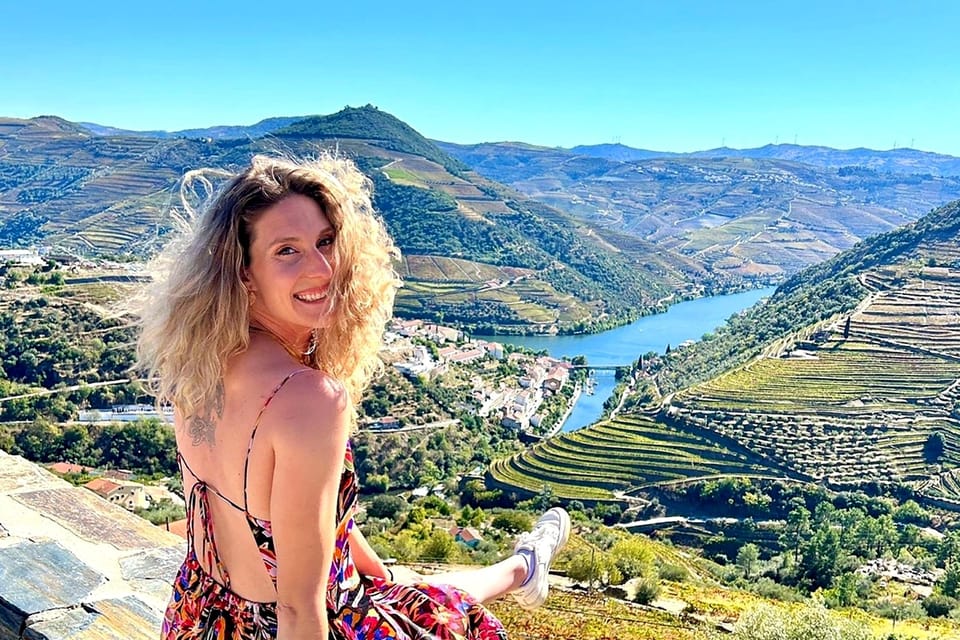
The Douro is the thing everyone says you must do from Porto, and with children it is the trip that most often goes wrong. Not because the valley is unsuitable – it is beautiful and children notice that – but because the day is built around two winery visits and a long drive, and a five-year-old has no use for either.
Here is what the operators actually say, what Portuguese law requires, and the honest version of who should go.
The arithmetic nobody puts in the title
Peso da Régua is about 100 km east of Porto. The drive is an hour and a half to two hours each way, and the road between Régua and Pinhão is the N222 – 27 kilometres with 93 bends, which is exactly as scenic and exactly as winding as that sounds.
A seven-hour trip therefore spends roughly three and a half hours in the vehicle. A nine-hour one spends four. The rest divides into two winery visits of about seventy-five minutes each, a lunch of an hour and a half to two hours, and an hour on the boat.
Of that, the parts a child is likely to enjoy come to about two hours. That is the number to weigh, and it does not change with the price.
Several trips also start with a hotel pickup between 7.30am and 8am, with the exact time sent only the evening before – so the day begins with waking children at an hour you do not yet know.
What the operators actually say about ages
This varies more than people expect, and it is stated on the booking page rather than in the title. Three real examples from trips currently sold in Porto:
One €55 trip requires that the age of any child under 8 is given in advance, because a child seat is mandatory; without that, the child cannot travel. The same operator states outright that it does not accept children under 7 at all.
Another €55 trip, from a different operator, carries the child-seat rule for under-8s but no lower limit.
A €90 two-region trip states plainly that it is not suitable for children under 10 years.
There is no general Douro minimum age, and anyone who tells you there is has made it up. Check the specific listing you are about to book – and if it does not say, ask before paying rather than at the kerb. Most operators also refuse unaccompanied minors, so a teenager cannot be sent on their own.
Car seats are the law here, not a courtesy
This catches families who assume a tour vehicle is like a taxi. It is not.
In Portugal, children under 12 years and under 135 cm must travel in an approved restraint suited to their size – the obligation ends when either threshold is cleared, so a tall eleven-year-old is exempt and a small thirteen-year-old is not. Approved means ECE R44/04 or ECE R129, and the rules apply to any car fitted with belts. Taxis and ride-hailing cars are the legal exception; tour vans are not.
That is why the age declaration matters. The operator has to bring the right seat, and cannot conjure one at 7.30am. If you are travelling with a child under 8 and the booking form has nowhere to say so, that is a reason to contact the operator, not a reason to hope.
What children actually like, and what they endure
The boat. One hour on flat water between the terraces; the rabelo boats at Pinhão have both open and covered seating. It is the best hour of the day for almost every age.
Lunch. Long, sitting down, and in a country where children are welcome at the table rather than tolerated.
The terraces themselves, briefly, from the viewpoints – a landscape that is obviously man-made and obviously enormous is easier to explain to a child than a cellar is.
The train, if there is one. One trip at €122.50 puts a half-hour panoramic stretch of the Douro line in the middle of the day, along with a ninety-minute cruise and a two-hour lunch at Tua, and that shape carries children far better than two cellars do.
What they endure is the rest: two guided estate visits, back to back, in which the subject of the entire conversation is a drink they are not having. Seventy-five minutes is a long time. Twice is longer.
When it is simply a bad idea
Under about four, or anyone who still naps. Seven hours, an early start, and a bendy road is not a day, it is an ordeal with a nice view in it.
If anyone in the family travels badly. The N222’s 93 bends come after lunch and after a tasting. If travel sickness is a known problem, a pharmacy in Porto can advise on what is suitable for a child’s age – that is a question for a pharmacist or your paediatrician, not for a travel website.
If this is your one flexible day. A day that goes wrong in the Douro goes wrong two hours from your hotel. There is no early exit.
If the appeal is the wine. Then go without the children if you can, and go on a small-group trip where the wine is actually explained. The three day-trip formats sets out which one that is.
The versions that work better with children
Go independently by train. The Douro line from Porto São Bento is one of the great European railway journeys, costs a fraction of any tour, and lets you turn round when the day has had enough. Doing the valley by train has the times and fares.
Pick the trip built around transport rather than tastings – boat, train, lunch, one winery. More movement, fewer cellars.
Pick a small group. Eight people in a van is a different day from a coachload when a child needs something, and several of the small-group trips run 4.9 across a thousand reviews or more. It costs €90 to €125.
Or stay in Porto. Two things are worth saying plainly: the valley will still be there, and the cellars in Gaia are twenty minutes from the middle of town – though what children may and may not do in a cellar is its own set of rules. A fifty-minute six-bridges cruise from €18 delivers most of the boat pleasure with none of the drive.
Things to settle before you pay, not on the day
Ask the operator, in writing, about the child seat and the declared age; about whether food and drink are allowed in the vehicle, because on some coaches they are not; about toilet stops on a two-hour drive; and about vegetarian or other dietary needs at lunch, which several operators grant only if asked before the day of the booking. What a trip includes and what it quietly does not is set out in what the €55 actually covers, and the full range sits in the Douro listings.