The Douro by train instead of a coach tour – who it suits
Updated September 17, 2026 · 7 min read
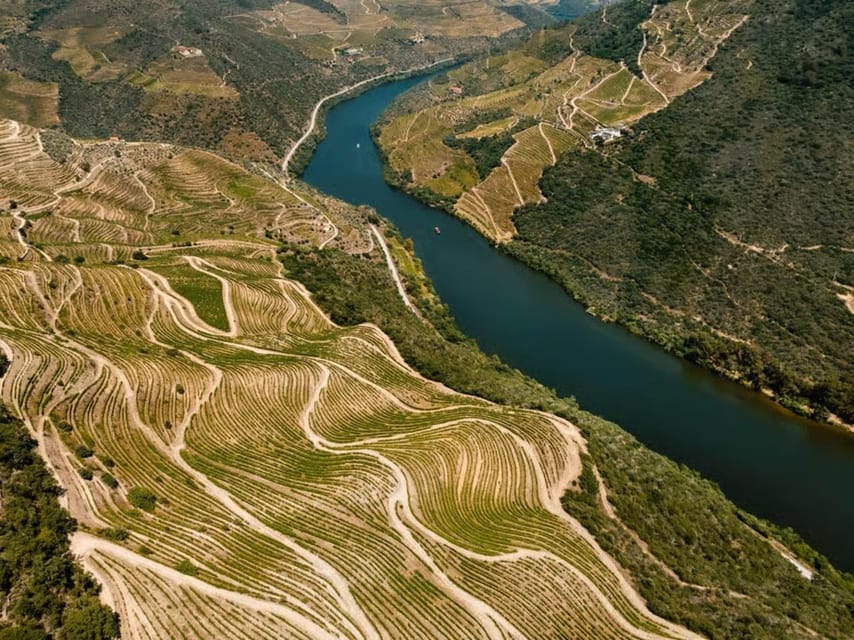
Every guided Douro day trip out of Porto costs between €50 and €125. The train that goes to the same valley costs a little over €12 each way, leaves from the most beautiful station in the city, and spends its last hour so close to the water that people lean out of the windows to photograph it.
It is not a substitute for a tour and it is not always the cheaper answer. But it is the option nobody in Porto will sell you, so here it is.
The line, the fare and the times
The Linha do Douro runs from Porto São Bento up the valley to Pocinho – 175 km, about three and a half hours end to end. Most visitors stop at Pinhão, which is the middle of the port country and about two and a quarter hours away on the faster services.
The fare is €12.20 one way to Pinhão and €14.80 to Pocinho, with roughly 10 % off a return. No reservation is needed and there is no seat allocation; you buy at the counter or online and get on.
On the timetable in force since 5 August 2026, trains leave Porto São Bento at 6.30am, 9.30am, 1.35pm, 3.20pm, 6.30pm, 7.25pm and 10.25pm, and arrive at Pinhão at 9.51am, 11.46am, 3.45pm, 4.22pm, 5.37pm and 7.49pm. Coming back, trains leave Pinhão at 8.08am, 12.18pm, 2.07pm, 4.41pm, 6.11pm and 8.24pm.
Not every departure goes the whole way, and CP changes the timetable several times a year – check cp.pt for the day you are travelling, not for today. One service is also flagged as possibly running with a replacement bus between Marco de Canaveses and Régua from Monday to Saturday, which is the kind of detail that ruins an afternoon if you find it out at the platform.
What the journey is actually like
The first hour out of Porto is suburbs and then inland country – pleasant, unremarkable. The river appears about two-thirds of the way along, and from there to Pinhão the track runs on the bank, often a few metres above the water.
The rolling stock is the point. Most services use carriages built by the Swiss firm Schindler with wide windows that open, which is why the photographs from this line look the way they do. They are second class only. There is no catering, no wifi and no power sockets, so bring water and something to eat – for a two-and-a-quarter-hour run that matters more than it sounds.
Sit on the right going out. The Douro is on that side for most of the way until Ferradosa, where it changes. Trains are rarely full outside summer weekends, so moving is usually possible.
Porto São Bento is the departure station, and it is also the one with 20,000 azulejos in the entrance hall, so arrive early enough to look at it. Campanhã, four minutes away on a suburban train, is the alternative if your service does not start at São Bento.
What you do when you get there
Pinhão is small – a station famous for its own tiled panels of the harvest, a quay, a couple of quintas reachable on foot, and not a great deal else. That is either exactly right or a disappointment, and which one depends on whether you booked anything.
The rabelo boat trips leave from the quay by the bridge, run one hour or two, and have covered and open seating. Some quintas take visitors who arrive without a car, which is worth confirming when you book. Peso da Régua, one stop back down the line, is bigger, has the Douro Museum, and is the better choice if you want a town rather than a village.
What you will not get without arranging it: a winery tour with a tasting at a fixed time. Book that directly with the quinta before you travel, or accept that your day is the river, lunch and the train.
The historic train, and what it is in 2026
Between 6 June and 18 October 2026, CP runs 51 journeys of the Douro Historical Train between Régua and Tua, on Saturdays, Sundays and some Wednesdays. It leaves Régua at 3pm, turns at 5.07pm and is back by 6.22pm – about three hours, with stops at Pinhão and Tua, a glass of port as a welcome at Régua and music on board.
It costs €60 for adults and €32 for children aged 4 to 12, with €56 a head for groups of ten or more.
One honest thing that is easy to miss when you book: for the 2026 season the train runs behind a 1400-series diesel locomotive from the 1960s in its original blue, not the steam engine. The five carriages are genuine early-twentieth-century stock and there are 254 seats. If you are travelling with somebody who wants a steam train, this is not it this year.
Note also that it starts at Régua, not Porto. You get there yourself – which is another €12 train and an early start.
When the coach tour is the better buy
Being honest about it: most of the time, for most people.
A guided day trip at €55 gives you two wineries, two tastings, lunch and an hour on the boat, delivered without a single decision. The train gives you the journey and nothing else, and once you add a boat trip, a quinta visit and lunch you have spent a good part of what the tour costs and organised it yourself. Our comparison of the three day-trip formats sets out what the guided versions include.
Take the train if you like trains, you want to set your own pace, you are travelling with children who would not survive two cellar visits, or you are going for two days rather than one and staying up there. The valley with children explains why the ability to turn round and come home matters.
Take the tour if your time in Porto is short, you want the wine explained, or the idea of arranging a quinta visit in a language you do not speak is the opposite of a holiday.
Or take the hybrid. One trip at €122.50 does the valley by van, boat and train in one day – a ninety-minute cruise from Pinhão, lunch at Tua, a half-hour panoramic stretch of this same line, and a winery at the end. It is the most expensive way to ride the Douro railway and the only one that also pours you something.
Everything else that leaves Porto for the valley is in the Douro listings, and if the river rather than the rails is the draw, boat against coach is the comparison to read next.