What a port lodge tour really costs – every step on the ladder
Updated September 17, 2026 · 7 min read
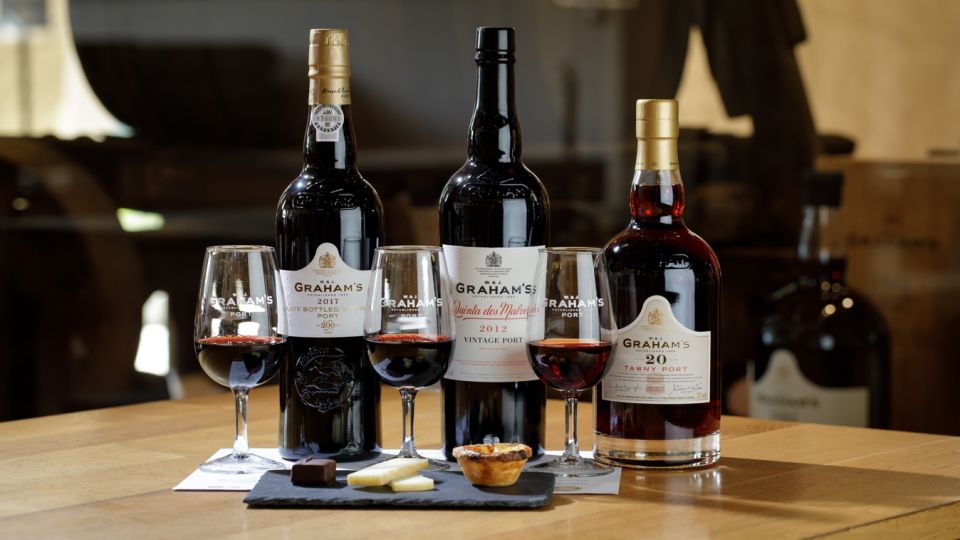
A cellar visit in Vila Nova de Gaia is advertised at anything between €16 and €70, for what looks from outside like the same hour: a walk past barrels, then a few glasses. The spread is real and it is explicable, but almost none of it is explained on the booking page. This is the ladder, priced from the current listings, with what each rung actually adds.
The base: €16 to €25
At the bottom sits Fonseca at €16, which is the plainest ticket among the big houses and a genuine uphill walk to reach. Real Companhia Velha is €20, Cálem €22 for a guided hour with its interactive museum, Burmester €22 self-guided or €23 with a host, Poças €23 for a guided tour and three ports, Sandeman €23, and Taylor’s €25 for the audio-guided version in thirteen languages, finishing with Chip Dry, a Late Bottled Vintage and a 10-Year-Old Tawny.
For that money you get the cellar, a guide or a headset, and two to three young wines – typically a white, a ruby and a basic tawny. Nothing in this band is a bad ticket, and the difference between €16 and €25 is mostly the building and the service, not the wine.
It is also where people actually book. The four most-reviewed cellar tickets in our listings – Cálem, Taylor’s, Cockburn’s and Cálem’s fado version – all sit between €22 and €30, with more than eighteen thousand reviews between them.
The first real step: €28 to €32
Cockburn’s at €30 is the outlier, and what earns its price is not the clock. At an hour and a half the tour is shorter than Taylor’s at €25 and Graham’s at €40, which both run two hours. What you pay for here is what stands in the room – the largest wooden cellar in Gaia and the only working cooperage in the district, where coopers repair barrels in front of you. Monday to Friday, 9am to 4.30pm only: come on a Saturday or Sunday and you pay the premium for a workshop standing still. Cockburn’s also takes visitors by reservation only.
The other €28 to €32 tickets are the same base visit with something bolted on, and the surcharge is visible if you line them up:
- Cálem with a fado show is €28 against €22 without. A live singer and guitarist in the cellar costs €6.
- Sandeman with chocolate is €32 against €23 plain, and Ferreira with chocolate is €32. A chocolate pairing costs about €9.
- Fonseca with fado is €25 against €16 plain, which is the same upgrade priced differently by a cheaper house.
Whether €6 for fado is good value is a matter of taste. Whether it is the cheapest live fado in the city is not: a standalone fado show with a glass of port starts at €20, so the cellar version is the one that saves money if you were going to do both.
Above €40 you are paying for the glass
Graham’s premium tasting is €40 – the 1890 lodge up the hill, chocolate, cheese and a pastel de nata alongside older wines. Taylor’s combined with a WOW museum pass is €50. Sandeman’s old-tawny visit is €53. Ferreira’s vintage tour is €55. Graham’s Vintage Room is €70.
The rule above roughly €40 is simple: the room is the same, the hour is the same, and what changes is what is in the glass – aged tawnies, colheitas and vintages that would cost a good part of the ticket by the bottle. That is either exactly what you want or completely wasted, and the honest test is whether you can already tell a 10-year-old tawny from a 20. If you cannot, the €70 ticket is teaching you an expensive lesson you could have had for €22. Our comparison of Cockburn’s, Sandeman and Graham’s sets out which house is worth the step up and why.
The costs that are not on the ticket
Getting up the hill. Taylor’s, Graham’s, Cockburn’s and Fonseca are on the slope, not the quay. The Teleférico de Gaia is €7 one way, €10 return, €3.50 and €5 for children aged 5 to 12, and €22.50 for a family return of two adults and two children. A taxi up and a walk down is the alternative. Either way it is €7 to €20 that the €22 ticket does not mention.
The bottle at the end. Every visit finishes in the shop, and that is not an accident – it is the business model, and the reason the ticket is priced at €22 rather than €45. Buying is entirely optional, and buying without doing the tour at all is a perfectly good plan.
Children who cannot drink. Portugal’s legal drinking age is 18 for all alcohol. Minors are admitted at the major houses and are usually poured grape juice instead, but the ticket is not always discounted – some houses publish a child price and others do not show one in the listing, so it is worth asking before you book four adult tickets.
The fifteen minutes at the end. Whatever you paid, the tasting is poured at a bar, standing, and takes about a quarter of an hour. If you were imagining an afternoon with a view, book a tasting room or a flight rather than a cellar tour – what each price actually pours goes through the difference glass by glass.
Meals attached. Several houses sell a visit with lunch or dinner alongside, and those start where the wine tickets end. They are restaurant prices with a tour attached, not tours with food included.
Where the money is genuinely saved
Book the morning slot. It is the same ticket at the same price, the cellars are emptier, and the language slots that sell out are the midday ones.
Take the self-guided option if you do not want a host. Taylor’s at €25 and Burmester at €22 both work this way, and neither sells out the way the guided tours do.
Skip the pairing and buy the pastel de nata afterwards from a bakery. The chocolate costs you €9 inside the lodge.
And if you are going to the Douro valley anyway, weigh the Gaia ticket against that day rather than adding it: a valley trip pours more wine, shows you the vineyards the barrels came from, and makes a second cellar visit feel like repetition. There are 135 wine experiences in the cellar and tasting listings at every point on this ladder, and the cheap end of it is not the disappointing end.