Port tasting in Porto – how many glasses are actually in the price
Updated September 17, 2026 · 6 min read
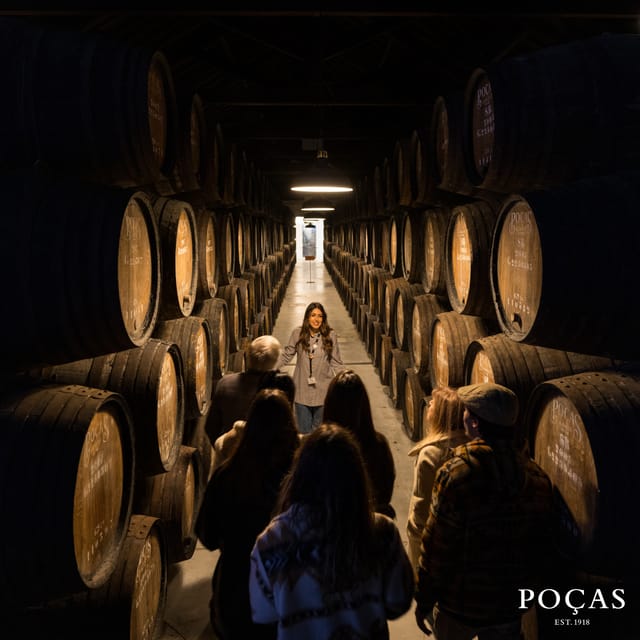
The listings for port tastings in Porto are unusually unhelpful about the one thing everybody wants to know. “Cellar tour and tasting” can mean two small glasses of a young ruby or four pours of thirty-year-old tawny, and the price gap between those is a factor of four. Here is what the money is actually for.
The three glasses that most tickets contain
The standard tasting across the Gaia lodges is three wines, poured at a bar at the end of the visit, in about fifteen minutes. Almost always it is the same three categories: a white port, a ruby, and a basic tawny. That is not laziness on the houses’ part – it is the shortest route through the styles, and if you have never drunk port before it is the right flight.
What changes between €16 and €30 is mostly the building and the guide, not the contents of the glass.
| Visit | Price from | Glasses | Per glass |
|---|---|---|---|
| Fonseca, self-guided | €16 | 3 | about €5 |
| Sandeman, guided | €23 | 3 | about €8 |
| Poças, guided | €23 | 3 | about €8 |
| Tasting with cheese pairing | €26 | 3 + cheese | about €9 |
| Graham’s premium tasting | €40 | not stated | – |
| Graham’s Vintage Room | €70 | not stated | – |
Two things fall out of that table. The cheapest ticket is not the worst wine – Fonseca pours its Bin 27, Siroco and Terra Prima, which are the house’s everyday wines and the same rank as what the €23 houses pour. The selection differs, though: Fonseca stays in the ruby family with Bin 27 and Terra Prima, while Sandeman (White, Ruby, Tawny) and Poças (White, LBV, Tawny Reserve) also cover the cask side. And above about €35 the lodges stop telling you how many glasses there are, which is the honest signal that you are no longer buying volume.
What you pay for above €40
Age. A ten-year tawny costs the house several times what a ruby costs, a twenty-year several times that again, and a vintage from a declared year is a different order entirely. Graham’s Vintage Room at €70 is a small separate room with aged tawnies and vintages, and the wines in it would take most of the €70 if you bought them by the bottle. Sandeman’s old-tawny session at €53 works the same way.
This is the part where the arithmetic stops being useful. Nobody drinks a forty-year tawny for the value per millilitre. But it does mean one thing worth acting on: if you cannot yet taste the difference between a ruby and a ten-year tawny, the €70 room is money spent on a distinction you are not able to notice yet. Do a €23 flight first. The upgrade will still be there tomorrow.
Where the cost per glass halves
Two formats break the pattern, and neither is a single lodge ticket.
Walking tastings. A guided wine walk pours far more for the money – there is a Porto and Douro wine walk through Vila Nova de Gaia that visits three wine houses and includes nine tastings at €49: under €6 a glass, and unlike a single lodge ticket it puts Douro table wines on the list as well. Three hours, a lot of walking, and by glass six the notes stop being notes.
Fado with a glass. A live fado show with a glass of port starts at about €15 in Porto, and several of those sit between €15 and €20. One glass, an hour of music. As a tasting that is nothing; as an evening it is a lot of port culture for the money. Cálem sells the combined version – cellar tour, tasting and a live fado set – at €28 against €22 for the plain tour, which is €6 for the music.
For comparison, the very cheapest entry in the whole wine listing is €6 – and it is a walking tour of Vila Nova de Gaia with no tasting at all. Worth knowing before you book on price alone.
Three places the price quietly goes up
The pairing. Chocolate or cheese alongside the wine costs extra: Sandeman’s chocolate tasting is €32 against €23 for the plain one, so €9 more. Not every pairing shows up in the price, though – Poças charges the same €23 for the tour with a pastel de nata as for the tour without. Worth checking case by case; what a pairing is not, in any event, is more wine.
The bar afterwards. Every lodge ends in a shop with a bar, and the glass you order there is priced like a bar, not like a tasting. This is where people who “only spent €23” leave having spent €45.
The second lodge. The spend most likely to go nowhere is two standard cellar visits in one day. The tours overlap almost completely, the second tasting lands on the first, and €50 has bought one memory. If you want a second thing, see what separates the big houses before you book two of them, or take the afternoon in a different direction – a river cruise is fifty minutes and about €18.
What is not in the price
The tasting is included in the ticket at every house in this article; you do not pay for the pour separately. Nor is there a surcharge for not drinking – children and non-drinkers are given Douro grape juice, and it is not cheaper.
Bottles are not included in anything. Lodge shops sell at list price, and the wines poured on the cheaper flights are the houses’ entry-level bottlings – the ones you can buy at home. If the point of the visit is to take something home, the ones worth carrying are the aged tawnies and colheitas on the upper tastings – at Sandeman that is the old-tawny session at €53, at Graham’s the Vintage Room at €70. The €40 Graham’s ticket, by contrast, is advertised as a premium tasting with chocolate, cheese and pastel de nata: more trimmings, not necessarily older wine.
The short answer
For a first port tasting, book a plain cellar visit between €16 and €25 and expect three glasses. If you know the categories already and want something you cannot get at home, the point is what is in the glass rather than the building: the old-tawny session at Sandeman for €53, or the Vintage Room at Graham’s for €70. If you want the most wine for the money, take a walking tasting rather than a lodge. And if you want to understand what you are drinking rather than how much, the Douro valley pours more, for longer, in front of the vines – which is a whole day rather than an afternoon.
Whichever way you go, start with the geography: none of these cellars is in Porto, and the walk across the bridge is part of the plan. There are 135 wine experiences in the full listing, with a median price of €50 – which tells you most of what you need to know about where the market actually sits.